Your Team Is Angry with You? Excellent.
Introduction: The Unseen Barrier to Breakthrough
We talk a lot about innovation – the shiny new technologies, the disruptive business models, the "early adopters" who leap at every new idea. But what if the greatest barrier to innovation isn't a lack of brilliant ideas, but a subtle, insidious force already present in your team?
As a recent exchange with a sharp Director of Innovation underscored, innovation is, at its core, a model of risk acceptance. But the risk we often overlook isn't financial or technical. It’s deeply human: the social risk of rejection.
The Deep Roots of Self-Censorship: A Childhood Lesson
Our brains are hardwired for safety. This isn't just about physical security; it extends to our social environment. Think back to childhood. If you were ever laughed at for a "weird" idea in class, or shamed for asking a "stupid" question, your brain learned a potent survival lesson: "Fit in to stay safe."
This deeply ingrained pattern follows us into adulthood and, critically, into the workplace. In a team setting, this translates into:
• Muffled Voices: Unique perspectives, the very fuel of innovation, are suppressed.
• Conformity Over Curiosity: We prioritize blending in over asking challenging "why" questions.
• Ignored Insights: Brilliant, nascent ideas remain unspoken, held hostage by the fear of judgment.
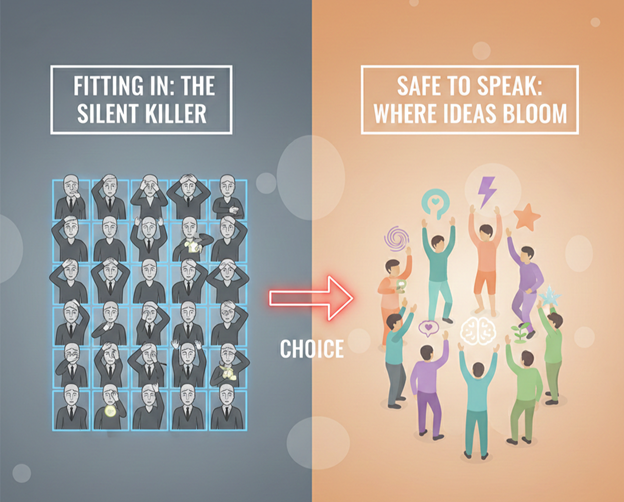
Fitting In: The Silent Killer of Innovation
When individuals on your team unconsciously strive to "fit in," the collective impact is devastating for innovation. You lose:
• The Edge: The unique, often counter-intuitive viewpoints that lead to breakthroughs never see the light of day.
• The Engine: Genuine curiosity, the driving force behind discovery and problem-solving, is stifled by the need to conform.
• The Truth: Employees hesitate to point out flaws, question assumptions, or suggest unconventional paths, leaving potential risks unaddressed and opportunities untapped.
From "Safe to Fail" to "Safe to Speak": The Leader's Essential Role
We often hear about creating a "Safe to Fail" environment for innovation – a crucial step. But it starts even earlier. It must be "Safe to Speak." An inclusive environment isn't merely a "soft skill" or an HR mandate; it is a fundamental business necessity for any organization aiming to innovate and thrive.
As a leader, your most impactful role isn't to have all the answers or even to be the "idea person." It's to be the architect of a psychological landscape where the brain's natural impulse to "fit in" is superseded by a deep sense of psychological safety. This means creating a space where:
1. Vulnerability is Valued: Team members feel comfortable admitting they don't know, asking for help, or sharing an idea that might seem incomplete or unconventional. It signals strength, not weakness.
2. Curiosity is Championed: Asking "stupid questions" is celebrated. Leaders actively model this behavior, demonstrating that inquiry is more valuable than always "having the answer."
3. Respect is Non-Negotiable: Even (and especially) during moments of disagreement or conflict, a baseline of mutual respect and acceptance of diverse perspectives is upheld. This transforms potential threats into opportunities for deeper understanding and creative tension.
The Actionable Takeaway for Leaders
If you genuinely want to foster more innovation, the answer isn't necessarily in hunting for more brilliant ideas outside your team. It's in cultivating the environment for the brilliant ideas already within your team to emerge.
Start by asking yourself: How do you actively make it "safe" to ask a "stupid" question or voice a half-formed idea in your meetings and daily interactions? The answers to that question will unlock your team's greatest innovative potential.